CivilTech Studio
RCC Beam & Column Section Design
Reinforced-concrete beam and column design with P-M interaction, biaxial bending and crack-width — IS 456, ACI 318, Eurocode 2.
- P-M and P-Mx-My in seconds
- Bresler biaxial check
- Crack-width per code
- Reinforcement optimisation
- IS 456:2000
- ACI 318-19
- Eurocode 2 (EN 1992-1-1)
What it does
Everything the check needs, in one pass
Design rectangular and circular reinforced-concrete sections for combined axial load, bending and shear. Plot P-M interaction diagrams, check biaxial bending per Bresler, run crack-width and serviceability checks, and export a code-referenced report.
P-M and P-Mx-My in seconds
Generate full interaction diagrams for rectangular, circular and L-shaped sections — point load + biaxial bending in one chart.
Bresler biaxial check
Bresler reciprocal load equation evaluated automatically for column sections with moments about both axes.
Crack-width per code
Crack width to IS 456 Annex F, ACI 318 Eq. 24.3.2 and EC2 §7.3 — same section, three answers, your call.
Reinforcement optimisation
The tool finds the lightest bar arrangement that meets ductility, spacing and cover constraints.
How it works
From inputs to a signed-off result
- Step 1
Define the section
Width, depth (or diameter), cover, bar grade, and concrete grade. Rectangular, circular or T/L sections.
- Step 2
Apply loads
Axial force, bending moment about either axis, and shear. Combine via standard load combinations or enter directly.
- Step 3
Run checks
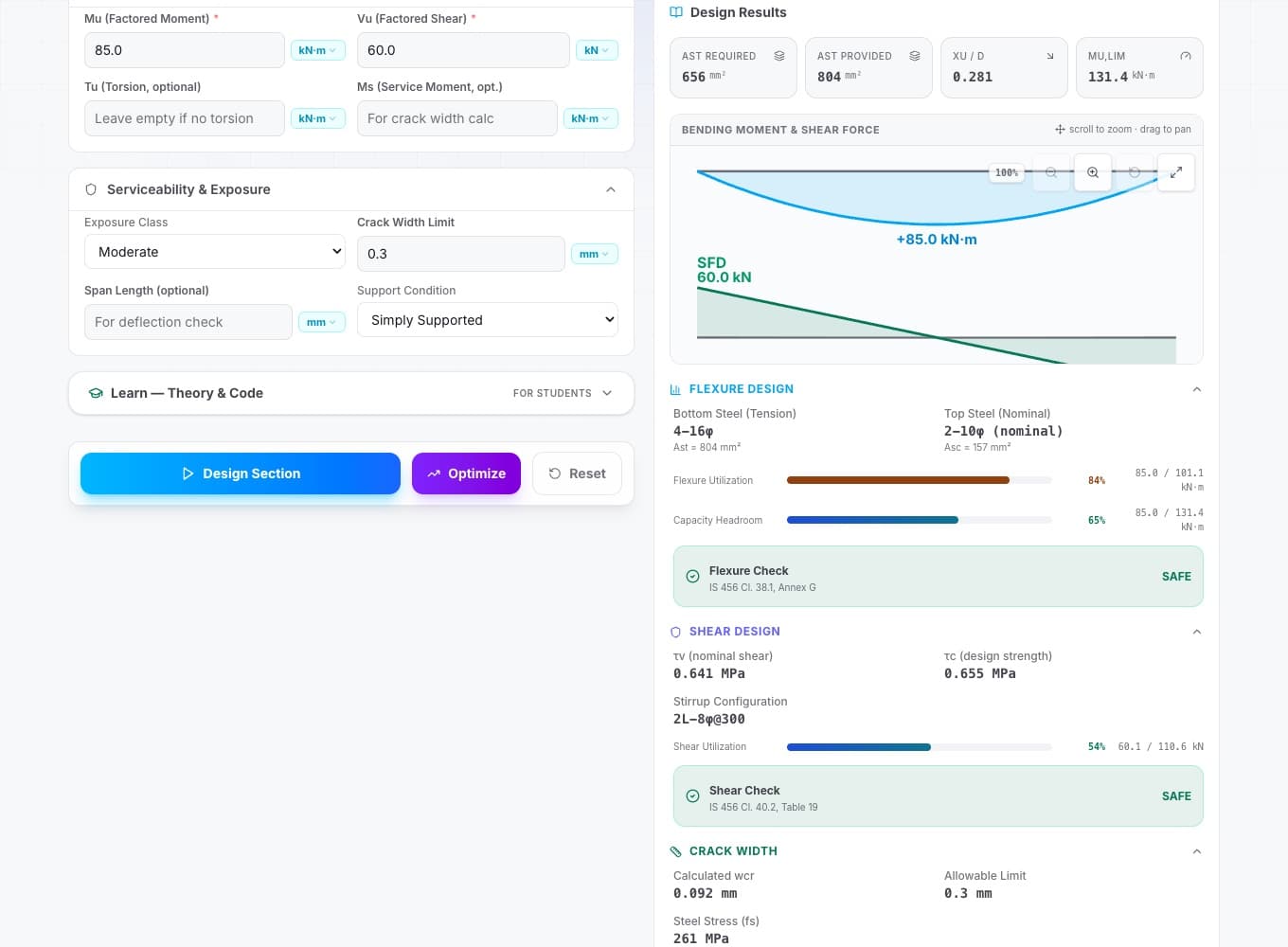
Flexure, shear, axial, biaxial bending, ductility and serviceability — code-specific factors applied automatically.
- Step 4
Inspect P-M diagram & export
Drag the load point on an interactive interaction diagram; export the section sheet to PDF.
Standards
Checked against the code, clause by clause
Every result cites the clause it came from, so a reviewer can follow the same path you did.
IS 456:2000
Indian RCC code, with SP-16 design aids
ACI 318-19
Strength design and unified design provisions
Eurocode 2 (EN 1992-1-1)
European concrete design code
Who it’s for
Where engineers reach for it
Multi-storey column at base
Heavy axial + biaxial moment from wind/seismic — the P-M-M envelope identifies governing combination.
Continuous T-beam
Flange in compression at midspan, rectangular at supports — the tool switches automatically.
Crack control in water-retaining beam
Tight crack-width limits to IS 3370 — bar spacing and stress are tuned automatically.
Retrofit assessment
Reverse-engineer a section from an existing drawing and check capacity for revised loads.
FAQ
Questions, answered
Something else? Open Section Design and try it with your own numbers.
Does it draw a P-M interaction diagram?
Yes — interactive P-M and P-Mx-My (3D) diagrams are generated for the chosen section with the load point drawn on top.
Can I check biaxial bending?
Yes. Bresler's reciprocal load equation is applied for rectangular and L-shaped columns; the tool returns the demand/capacity ratio.
What about T-beams and L-beams?
T and L flanged sections are supported in flexure, with effective flange width computed automatically per code rules.
Does it compute crack width?
Yes — under sustained loading, crack width is computed per IS 456 Annex F / ACI 318 Eq. 24.3.2 / EC2 §7.3 depending on the chosen code.
Can I check shear stirrups?
Yes. Stirrup spacing and area are designed for the applied shear, with minimum-spacing and maximum-spacing limits enforced.
Open Section Design and run your numbers
Reinforced-concrete beam and column design with P-M interaction, biaxial bending and crack-width — IS 456, ACI 318, Eurocode 2.
Get 10 free credits — no card required
Sign up to save projects, export PDFs, and access all design tools.