CivilTech Studio
Geotechnical Analysis Calculator
Safe bearing capacity from SPT N-values, liquefaction screening and soil classification — IS 6403, Terzaghi, Meyerhof and Bowles.
- Four methods, one borehole
- NCEER liquefaction screening
- Multi-layer soil model
- Designed for foundation handoff
- IS 6403:1981
- IS 1893 (Part 1):2016
- Terzaghi (1943)
- Meyerhof (1956)
- Bowles (1996)
What it does
Everything the check needs, in one pass
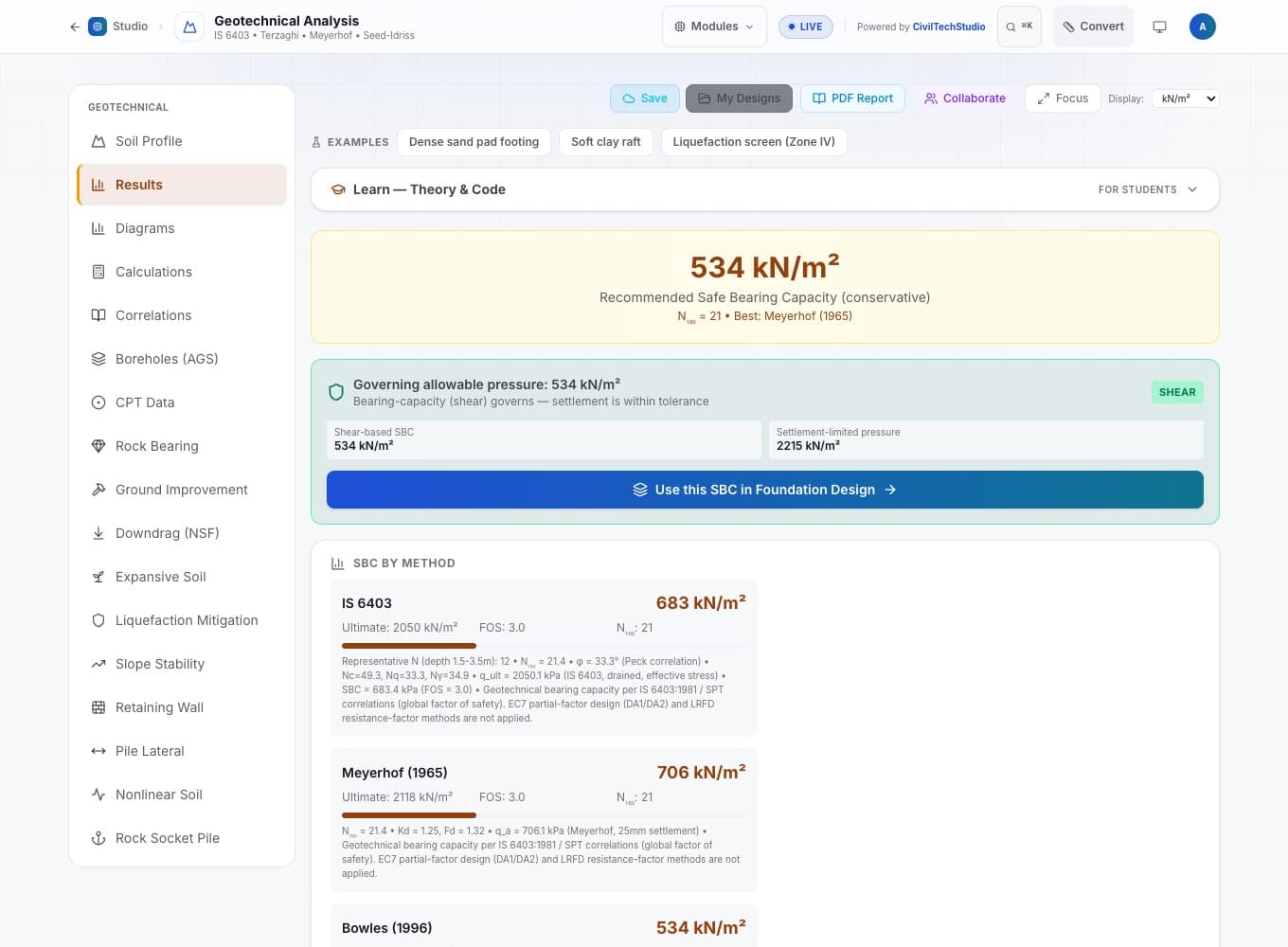
Estimate safe bearing capacity from a borehole log in minutes. Apply N-value corrections (overburden, rod-length, hammer energy), compute SBC by four methods, and screen for liquefaction per IS 1893 and the NCEER simplified procedure.
Four methods, one borehole
See SBC from IS 6403, Terzaghi, Meyerhof and Bowles in the same chart — judge engineering scatter at a glance.
NCEER liquefaction screening
Cyclic stress ratio vs cyclic resistance ratio for every layer — flagged red where FS < 1.0.
Multi-layer soil model
Up to 20 soil layers per borehole with independent unit weight, water table and SPT corrections per layer.
Designed for foundation handoff
The SBC profile exports straight into the Foundation Design module — no copy-paste between tools.
How it works
From inputs to a signed-off result
- Step 1
Enter borehole log
Layer thickness, soil type, SPT N-values and water-table depth.
- Step 2
Apply corrections
Overburden (CN), rod length (CR), hammer energy (CE) and borehole diameter (CB) — toggle individually.
- Step 3
Compute SBC by method
IS 6403, Terzaghi, Meyerhof and Bowles — settlement-controlled and shear-controlled SBC reported separately.
- Step 4
Screen for liquefaction
CSR vs CRR per layer with peak ground acceleration; layers below FS = 1.0 are flagged in red.
Standards
Checked against the code, clause by clause
Every result cites the clause it came from, so a reviewer can follow the same path you did.
IS 6403:1981
Indian code for safe bearing capacity of shallow foundations
IS 1893 (Part 1):2016
Seismic design — liquefaction susceptibility
Terzaghi (1943)
Classical bearing capacity equation
Meyerhof (1956)
SPT-N to SBC correlations
Bowles (1996)
Modern SPT-based bearing capacity correlation
Who it’s for
Where engineers reach for it
Pre-design ground report review
Sanity-check a soil consultant's SBC by running the same N-values through four methods.
High-seismic zone screening
Cities in seismic zones IV and V — liquefaction screening informs whether ground improvement is needed.
Loose sand site
Where N < 10, SBC is settlement-controlled — Bowles vs Meyerhof gives different answers; the tool surfaces both.
Quick proposal pricing
Estimate SBC quickly to decide pad vs raft vs pile before full geotechnical investigation.
FAQ
Questions, answered
Something else? Open Geotechnical Analysis and try it with your own numbers.
Which N-value corrections are applied?
Overburden (CN), rod length (CR), hammer energy (CE) and borehole diameter (CB). Each can be toggled if the field log has already corrected for them.
Does it perform liquefaction analysis?
Yes — NCEER simplified procedure with CSR / CRR by layer, plus IS 1893 susceptibility checks. PGA can be entered manually or pulled from seismic zone.
Which SBC method should I trust?
For most Indian projects, IS 6403 governs. The other three are shown for engineering judgement — wide scatter usually means more investigation is needed.
Can I model layered soils?
Yes. Up to 20 layers with independent properties; the tool computes a settlement-weighted average SBC at the chosen footing depth.
Does it integrate with the foundation design tool?
Yes — the SBC profile flows directly into the Foundation Design module so design depth and bearing pressure stay consistent.
Open Geotechnical Analysis and run your numbers
Safe bearing capacity from SPT N-values, liquefaction screening and soil classification — IS 6403, Terzaghi, Meyerhof and Bowles.
Get 10 free credits — no card required
Sign up to save projects, export PDFs, and access all design tools.