CivilTech Studio
Septic Tank & Soak Pit Design
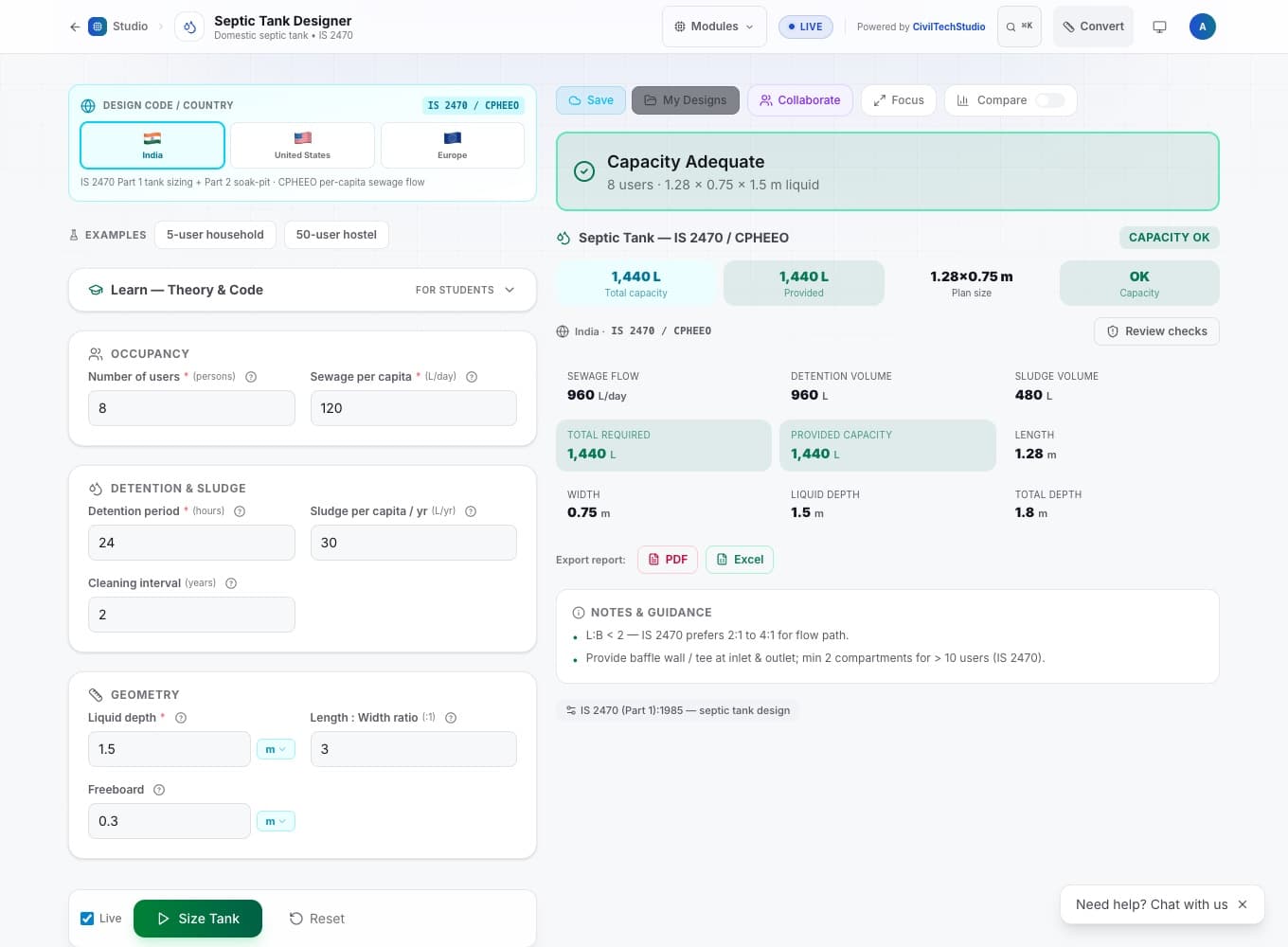
Size a domestic septic tank and soak pit from the population served — to IS 2470.
- Population-based sizing
- Detention + sludge storage
- Soak pit / dispersion
- Practical proportions
- IS 2470 (Part 1):1985
- IS 2470 (Part 2)
- CPHEEO Manual
What it does
Everything the check needs, in one pass
From the population served, compute the sewage flow, the liquid volume for the detention time, the sludge & scum storage between desludging, and the resulting tank dimensions plus a soak pit / dispersion area for the effluent.
Population-based sizing
Sewage flow and tank volume derived from the number of users and per-capita flow.
Detention + sludge storage
Liquid volume for 24–48 h detention plus sludge storage to the desludging interval.
Soak pit / dispersion
Sizes the effluent soak pit from the soil percolation rate.
Practical proportions
Length:width and free-board kept within IS 2470 limits for effective settling.
How it works
From inputs to a signed-off result
- Step 1
Enter the population
Number of users and the per-capita sewage flow.
- Step 2
Set detention & desludging
Detention time and the desludging interval.
- Step 3
Size tank & soak pit
Liquid + sludge volume → tank dimensions, then the soak pit from percolation.
- Step 4
Review & export
Tank size, soak pit and the design notes.
Standards
Checked against the code, clause by clause
Every result cites the clause it came from, so a reviewer can follow the same path you did.
IS 2470 (Part 1):1985
Septic tank design & capacity
IS 2470 (Part 2)
Soak pit / dispersion trench
CPHEEO Manual
Per-capita sewage flow
Who it’s for
Where engineers reach for it
Single household
A family septic tank with a soak pit on a permeable site.
Small apartment block
A shared tank sized for a larger population.
Clay / low-percolation site
A larger dispersion area where the soak rate is low.
School / institutional
A bigger tank with proportioned compartments.
FAQ
Questions, answered
Something else? Open Septic Tank Designer and try it with your own numbers.
What detention time is used?
Typically 24–48 hours at the design flow; the liquid volume = flow × detention time.
Is sludge storage included?
Yes — extra volume is added for sludge and scum accumulation up to the desludging interval so the detention volume is preserved.
Does it size the soak pit?
Yes — the effluent dispersion area is sized from the soil percolation rate; clayey soils need a larger area.
Two compartments or one?
A baffle / two-compartment layout avoids short-circuiting and improves settling; it is recommended for larger tanks.
What if the soil percolates poorly?
A low percolation rate enlarges the soak pit; very poor soils may need a dispersion trench or an alternative disposal method.
Open Septic Tank Designer and run your numbers
Size a domestic septic tank and soak pit from the population served — to IS 2470.
Get 10 free credits — no card required
Sign up to save projects, export PDFs, and access all design tools.